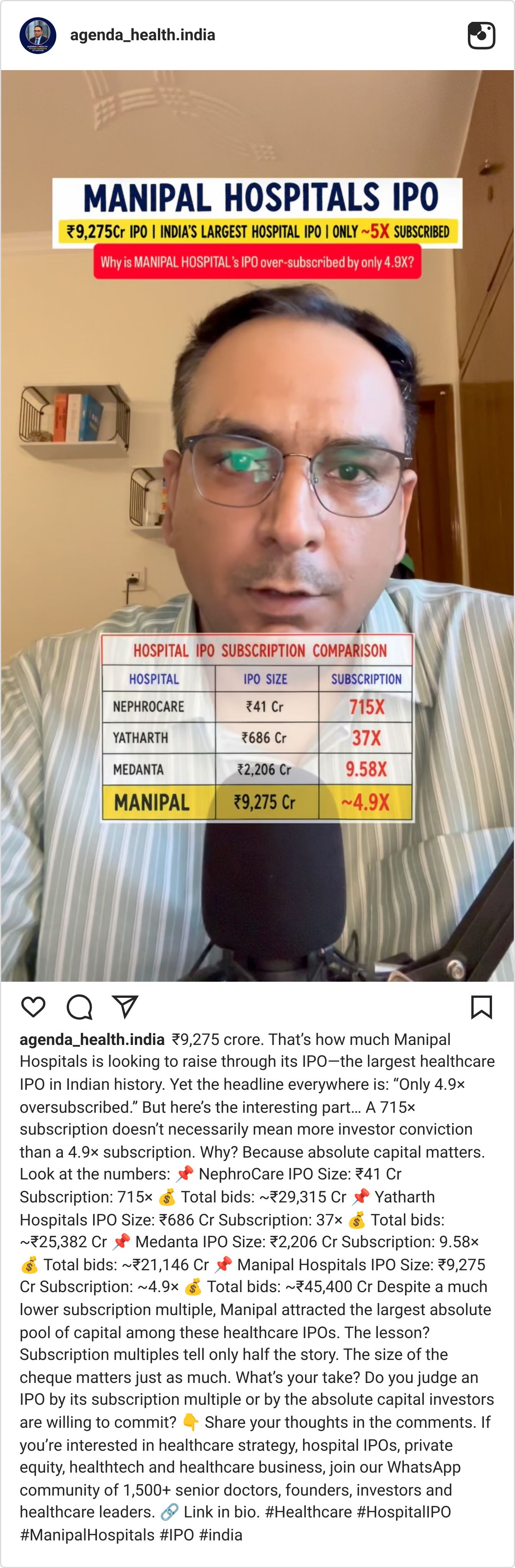
When I started analysing Manipal Hospital’s IPO, I thought I was decoding one company. Instead, I stumbled upon something much bigger.
Over the past few weeks, I analysed the annual reports of India's largest hospital chains, compared their specialty mix, studied their revenue concentration, and even contrasted Manipal with Zepto.
At first glance, these seem like unrelated analyses. But together they tell one powerful story. The future of Indian healthcare may not be decided inside hospitals alone.


1. India's largest hospitals are increasingly becoming disease specialists.
When I analysed eight of India's largest hospital chains, one pattern became impossible to ignore.

57%–83% of hospital revenue comes from just six specialties.
Cardiac.
Orthopaedics.
Neurology.
Gastroenterology.
Oncology.
Renal.
(CONGO-R) Even more interesting...
Cardiology and Oncology alone contribute nearly half of this revenue.
That immediately raises a question. Are hospitals driving this trend? Or is India's disease burden changing?
Probably both.
India today has:
100+ million people living with diabetes
Cardiovascular disease remains the country's leading cause of death
1.5 million new cancer cases every year—with incidence expected to continue rising.
2. Maybe we're comparing hospitals the wrong way.
Traditionally we compare hospitals using:
Revenue
EBITDA
Beds
Market share

But perhaps a more meaningful comparison is: Which disease does this hospital aspire to own?
Narayana Health became synonymous with cardiac care.
Max Healthcare has aggressively strengthened oncology.
Apollo Hospitals built one of India's broadest tertiary-care portfolios.
Manipal Hospitals continues investing in high-acuity specialties.
Increasingly, hospitals appear to be competing on clinical identity—not just infrastructure.
Perhaps the next decade won't be a battle of beds. It will be a battle of specialties.
3. Then came an unexpected comparison.
Manipal vs Zepto.
Initially, it looked absurd.

One built hospitals over 70 years. The other built a convenience platform in under a decade.
Yet both attracted IPOs of comparable scale. The lesson was NOT that Zepto is more valuable. Or that hospitals are less valuable.
The lesson is this:
Capital is rewarding 2 different forms of infrastructure.
Manipal built healthcare infrastructure. Zepto built consumer behaviour.
Healthcare may never become retail. But patients increasingly behave like consumers.
They expect:
faster appointments
transparent pricing
digital reports
seamless communication
convenience
That shift may redefine healthcare strategy over the next decade.
4. The uncomfortable question
If Cardiology and Oncology dominate hospital revenues...
what does that say about India?
Perhaps we have become exceptionally good at treating advanced disease. But are we equally good at preventing it?
Insurance largely rewards hospitalisation.
Hospitals optimise around those incentives.
Patients usually visit tertiary hospitals only after disease becomes severe.
The result is predictable.
Our system becomes exceptionally efficient at treatment.
Not prevention.
5. So where does the next opportunity lie?
Perhaps the next healthcare unicorn won't simply build another hospital.
It may build:
preventive care
chronic disease management
primary care
longitudinal care
AI-enabled monitoring
population health
The biggest opportunity may be delaying hospitalisation—not increasing it.
6. One question I can't stop thinking about
Every iconic Indian hospital chain began with one extraordinary doctor.
Dr. Devi Shetty. Dr. Naresh Trehan. Dr. Prathap Reddy.
Each transformed expertise in 1 specialty into an institution. Today's leading specialists arguably possess even greater advantages:
stronger personal brands
social media
AI
digital reach
easier access to capital
So why aren't more specialists building tomorrow's hospital platforms? Has entrepreneurship become harder? Or has corporate healthcare become too comfortable?
A few insightful comments from my followers & fellow HCPs
One of the most rewarding aspects of publishing these analyses was the thoughtful discussion they sparked among senior healthcare leaders.
Here are a few perspectives that particularly stood out.
The opportunity lies in shifting incentives from treatment to prevention.
Perhaps the biggest opportunity isn't another hospital tower. It is redesigning incentives across the ecosystem.
Corporate hospitals are responding to the ecosystem they operate in—not creating it.
She rightly pointed out that prevention extends far beyond hospitals. It depends on nutrition, public health, urban design, policy and behaviour. Hospitals alone cannot solve a systemic problem.
Case-mix optimisation is a management discipline—not merely a clinical outcome.
His comment highlighted another important dimension.
Hospital specialty mix is shaped not only by disease burden but also by management capability, incentives, capacity planning and execution.
Perhaps we are still looking at healthcare through the hospital's balance sheet rather than the nation's health report card.
This was probably my favourite observation.
Because hospital revenue and national health are not always measuring the same thing. A healthy healthcare system isn't one where ICUs remain full. It's one where fewer people ever need them.
The CONGO-R concentration is the financial signature of a prevention system that doesn't yet exist.
He drew parallels with Kaiser Permanente's integrated provider-payer model, arguing that until prevention becomes economically rewarding, treatment will continue to dominate.
My biggest takeaway
This newsletter started as an attempt to understand Manipal Hospitals. It evolved into something much bigger. It became a conversation about:
India's disease burden
Hospital economics
Consumer behaviour
Insurance incentives
Preventive healthcare
And where the next decade of healthcare innovation may emerge.
That's exactly the kind of discussion I hope this newsletter continues to spark.